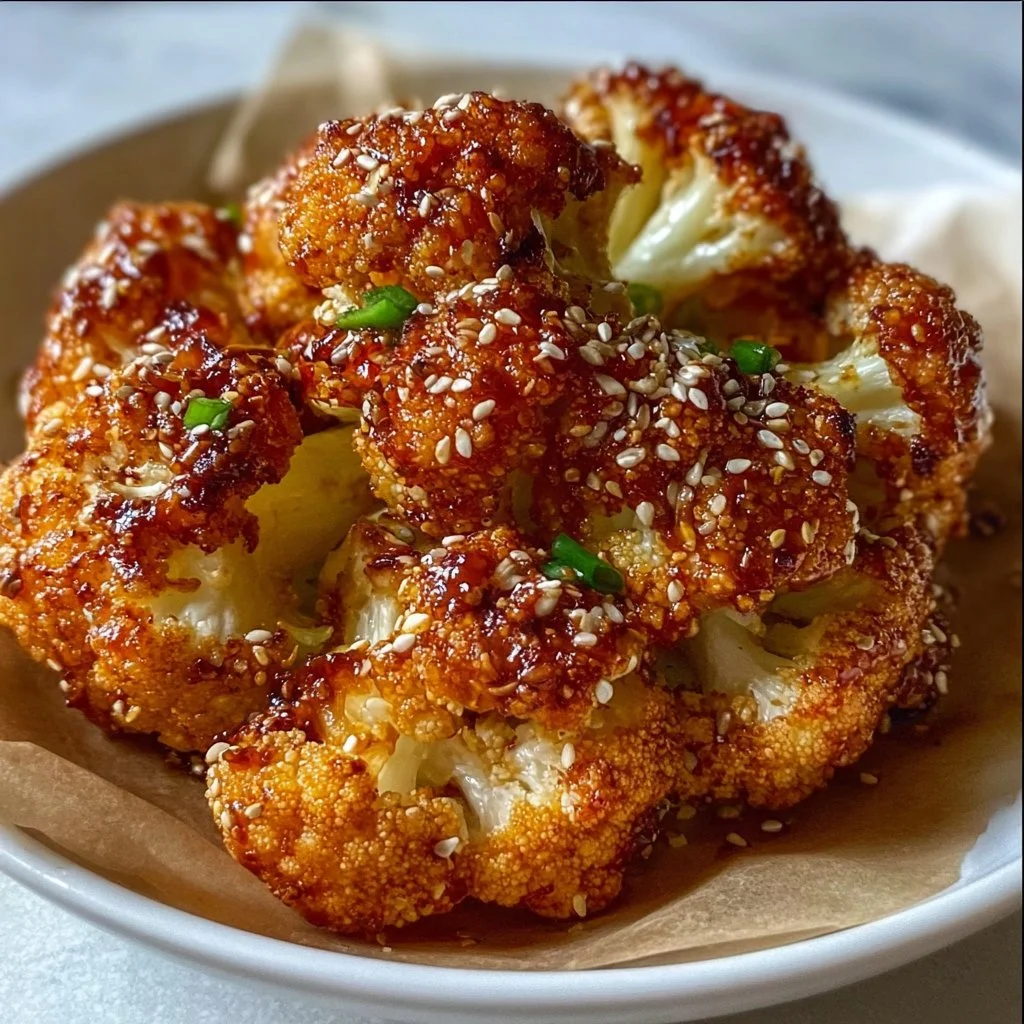
Korean Baked Cauliflower
While we have provided a jump to recipe button, please note that if you scroll straight to the recipe card, you may miss helpful details about ingredients, step-by-step tips, answers to common questions and a lot more informations that can help your recipe turn out even better.
Bold truth: if cauliflower had a fan club, I’d be president, vice-president, and the person who brings the weird dip no one asked for. My strongest belief aside from the sanctity of butter — which I will defend in the grocery aisle if necessary — is that Korean Baked Cauliflower deserves a trombone solo and a standing ovation. Also: this will make your house smell like a comforting, mildly spicy temple of roasted vegetables. Two-word verdict: wildly addictive.
How I turned Thanksgiving into a cauli-incident (and lived to tell the tale)
Once, during the Green Bean Casserole Fiasco of 2018 (a true Midwest epic — casserole airborne, aunt offended), I decided to redeem myself by bringing something “safe” to Thanksgiving. Safe meaning: roasted cauliflower, because how can you mess up roasted cauliflower, right? Famous last words. I over-sauced it, under-roasted it, attempted a flambé for drama (don’t do that), and produced something that looked like charcoal and tasted like regret. Family still talks about it. I felt seen. I learned things. Mostly, I learned to trust heat and timing and to stop trying to impress with pyrotechnics.
Anyway, before I emotionally relive that entire timeline and cry into a bag of Trader Joe’s everything but the bagel seasoning (again), meet the redemption arc: Korean Baked Cauliflower. It’s sticky, savory, bright, and safe enough for potlucks but bold enough to make your weird cousin ask for the recipe.
Ingredients (straight-up, no fuss — plus my shopping gripes)
- 1 large head cauliflower, cut into florets
- 2 tablespoons olive oil
- 1/2 teaspoon salt
- 1/2 teaspoon black pepper
Sauce:
- 2 tablespoons gochujang
- 2 tablespoons soy sauce
- 1 tablespoon sesame oil
- 1 tablespoon honey or maple syrup
- 1 teaspoon rice vinegar
- 2 garlic cloves, minced
- 1 teaspoon fresh ginger, grated
Garnish:
- 1 teaspoon toasted sesame seeds
- 2 green onions, sliced
Shopping mini-rant: yes, you can splurge on a premium gochujang, but Trader Joe’s and Aldi have perfectly competent jars that will not judge you (and neither will your wallet). If you’re feeling bougie, buy a small jar of toasted sesame oil at the specialty aisle — it’s worth the drama. Also, if you need fresh cauliflower that doesn’t look like it survived a flood, check the farmer’s market on Saturday mornings — sunlight makes everything taste better, including my tears.
Cooking Unit Converter (because math and I are frenemies)
Quick conversions for oven-wielding humans who don’t love calculators.
Technique breakdown (the part where I confess everything I’ve learned — loudly)
Listen: roasting is 90% patience and 10% being willing to flip a baking sheet like you mean it. Here’s what I’ve learned the hard way — don’t crowd the pan, don’t baby the sauce, and for the love of garlic, don’t skip the flip. Textures change like moods: soft inside, crisp at the edges, glossy with gochujang, whispering salt. The sauce? It should cling like a good hug, not puddle like a tragic soup. If you want it thicker, simmer it down; if you want drama, toss then roast again until it sings.
- Preheat oven to 400°F (200°C).
- Toss cauliflower florets with olive oil, salt, and pepper; spread on a baking sheet in a single layer. Roast 25–30 minutes, flipping halfway, until golden brown and crispy at edges.
- In a small bowl, whisk gochujang, soy sauce, sesame oil, honey, rice vinegar, garlic, and ginger until smooth.
- If you prefer thicker sauce, simmer in a small saucepan over medium heat 3–5 minutes until slightly thickened.
- Remove cauliflower from oven, drizzle or toss with sauce to coat; return to oven for 5 minutes for a more caramelized coating, if desired.
- Garnish with sesame seeds and green onions. Serve hot as a side, appetizer, or main with rice or noodles.
Also: don’t be shy with timing adjustments. Oven runs hot? Drop five minutes. Want extra char? Add three. Food is negotiable. Life is not. (Okay, sometimes life is.)
I once served this to my neighbor who had just returned from a mysterious trip and declared it “like eating a warm, comforting Korean hug.” I cried. She laughed. We ate more. Community: built.
Why food tethers me to people (yes, I’m sentimental about vegetables)
Cooking is memory in motion. A whiff of sesame oil and suddenly you’re seven, stealing a bite off someone’s plate while they weren’t looking — or you’re older, sitting at a Thanksgiving table where someone finally forgave you for the casserole. Food is lineage; it’s the thing we pass through hands and mouths and, occasionally, through tears. This cauliflower? It’s my apology, my celebration, and my crunchy rebellion against boring sides.
Tiny anecdote: the time I learned flip-flopping isn’t just for politicians
Last month I attempted to flip an entire tray of roasted cauliflower like a certified adult and ended up with one gloriously airborne floret landing in my cat’s water bowl. He looked offended; so did my partner; so did I. We salvaged dinner. I vowed to be less showy with the pan. Promise kept, mostly.
Yes — use tamari or a gluten-free soy sauce and double-check your gochujang (some brands add wheat). Your tummy and your relatives who read labels will thank you.
You can! Air-fry at 390°F for about 15–18 minutes, shaking halfway, but watch for quick browning — air-fryers are dramatic and fast, like my aunt at bingo night.
It has heat, but it’s more complex: sweet, umami-rich, and tangy. If you’re spice-averse, halve it and add a splash more honey — no judgment (mostly).
Okay, dramatic pause. I could write the history of my kitchen mishaps until dawn, but I’ll spare you (and my cat). Make this, bring it to Thanksgiving if you dare, and if someone mentions “the casserole incident,” hand them a floret and say, “Start anew.” Oh, and if you want to pair it with something pillowy and warm, I once tried it with freshly baked homemade bread and that was chaos in a good way. For a morning-after vibe, this also pairs unexpectedly well with ideas from my piece on Korean breakfast with traditional dishes. And if you’re shopping strategically (because we are adults now), snag a good jar of gochujang and some green onions (Trader Joe’s usually has them looking heroic) — I even wrote about pairing it with quick breads elsewhere if your hosting skills need props: grab that bread recipe.
Daily Calorie Needs Calculator (for the calorie-curious among us)
A tiny tool to estimate how much roasted-cauli joy fits into your daily calorie goal.
Korean Baked Cauliflower
Ingredients
Method
- Preheat oven to 400°F (200°C).
- Toss cauliflower florets with olive oil, salt, and pepper; spread on a baking sheet in a single layer.
- Roast for 25–30 minutes, flipping halfway, until golden brown and crispy at edges.
- In a small bowl, whisk gochujang, soy sauce, sesame oil, honey, rice vinegar, garlic, and ginger until smooth.
- If you prefer thicker sauce, simmer in a small saucepan over medium heat for 3–5 minutes until slightly thickened.
- Remove cauliflower from oven, drizzle or toss with sauce to coat; return to oven for 5 minutes for a more caramelized coating, if desired.
- Garnish with sesame seeds and green onions. Serve hot as a side, appetizer, or main with rice or noodles.